Sangaku for all
What is the area of the marked region?
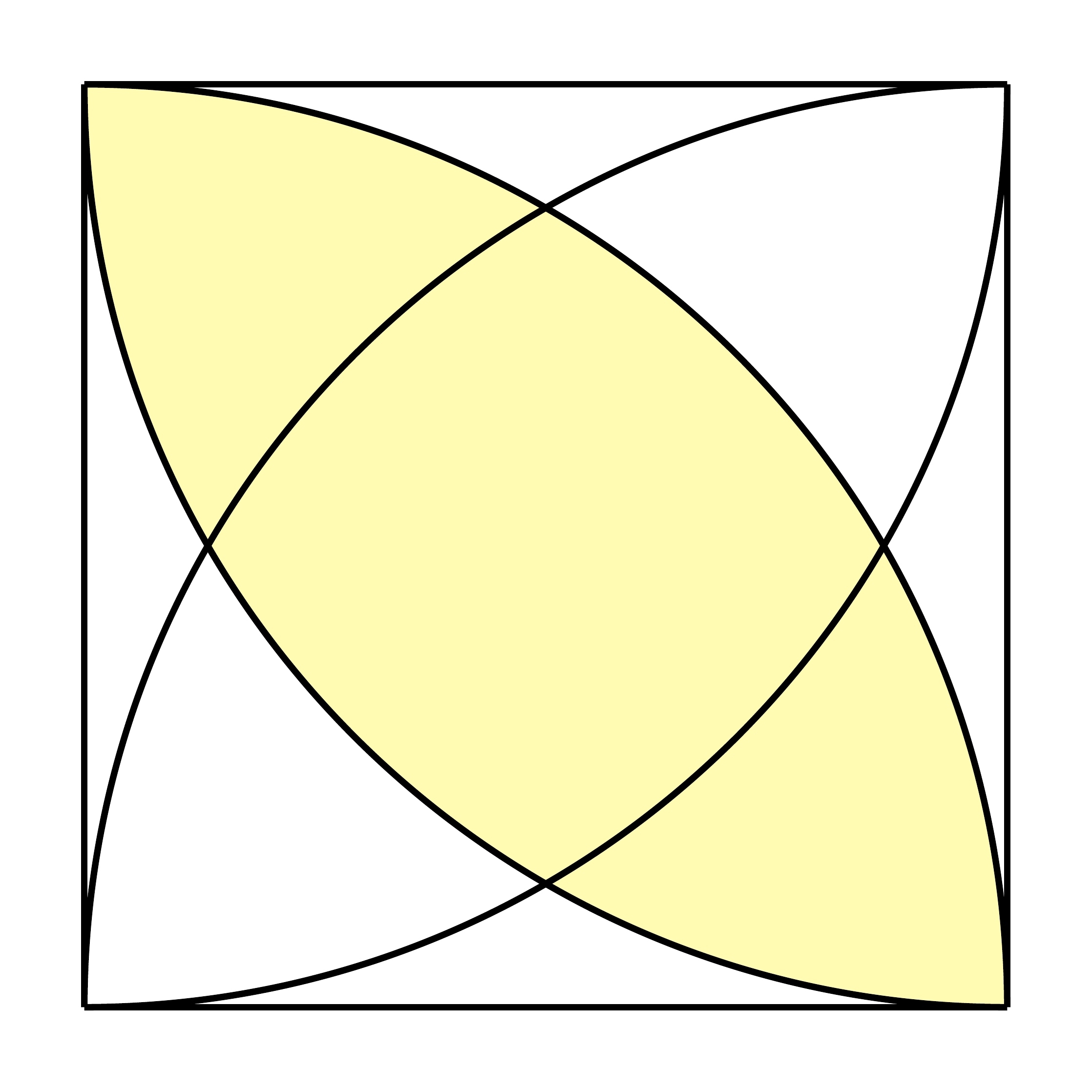
Consider the regions in the following picture.
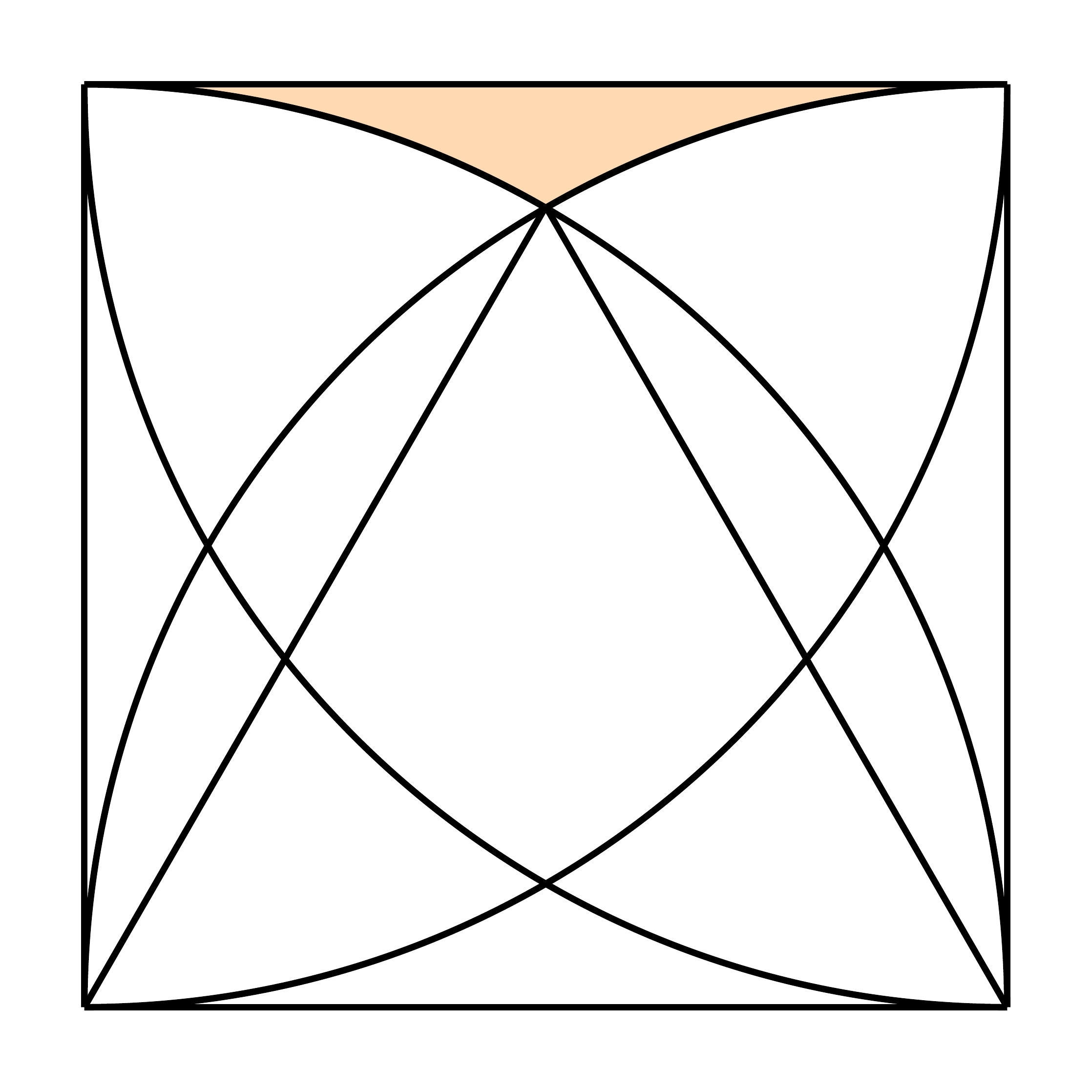
The triangle has one side in common with the square.
The triangle is equilateral because its sides are radiuses of congruent circles.
The equilateral triangle with side length \(1\) has area \(\dfrac{\sqrt{3}}{4}\).
The two circular sectors have radius \(1\).
Since the angles of the equilateral triangle are \(60^\circ\), the central angle of each circular sector is \(30^\circ\).
Thus, each circular sector is one twelfth of a circle with radius \(1\).
The area of the marked region is the area of the square minus the area of the equilateral triangle and the area of the two circular sectors.
So it is \[1-\dfrac{\sqrt{3}}{4}-2\cdot \dfrac{\pi}{12}=1-\dfrac{\sqrt{3}}{4}- \dfrac{\pi}{6}\,.\]