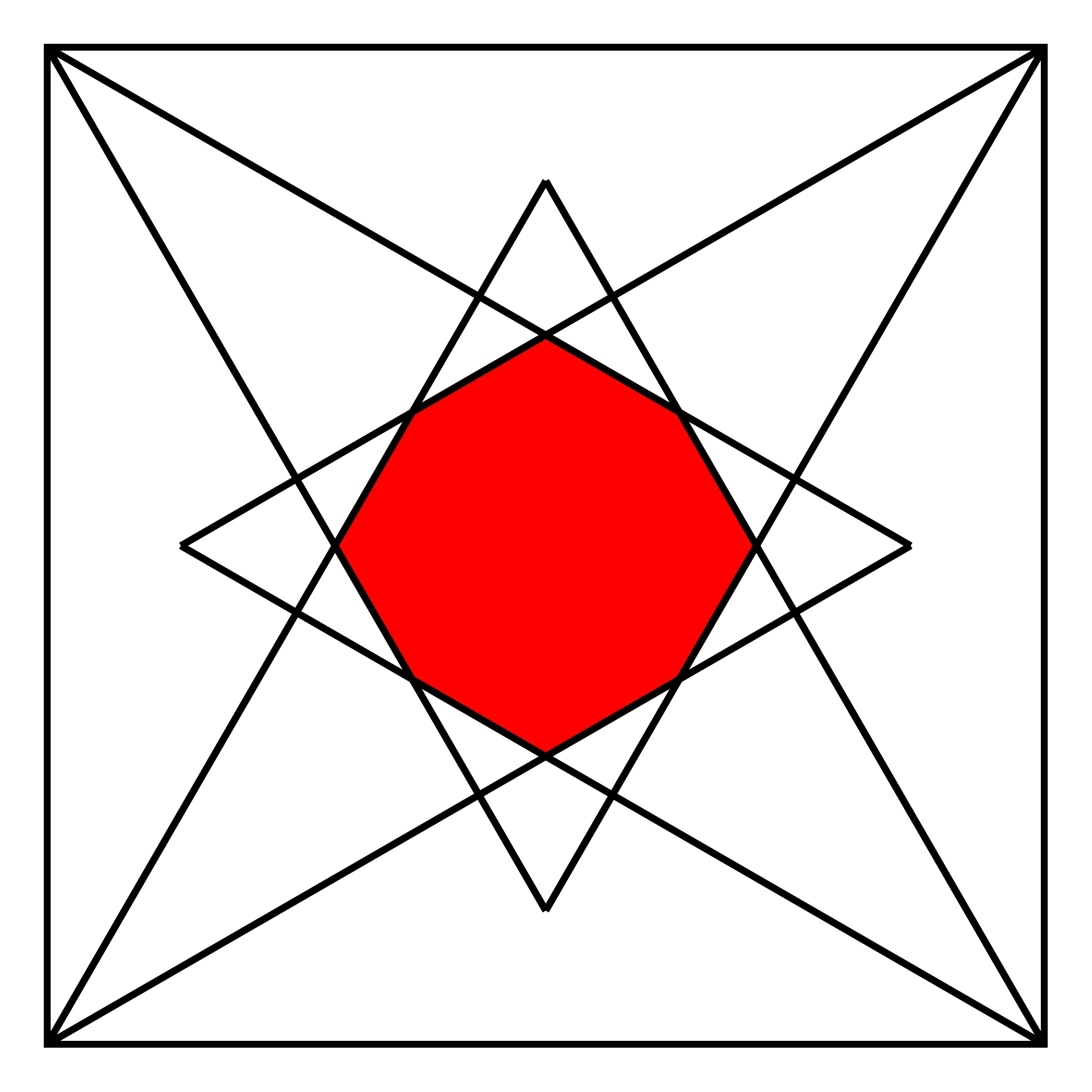
The marked region is an octagon.
It is symmetric at the two diagonals of the square.
It is also symmetric at the two lines going through the midpoints of two opposite sides of the square.
Thus, the octagon has a rotational symmetry by \(90^\circ\).
Because of the symmetry, the octagon sides have the same length.
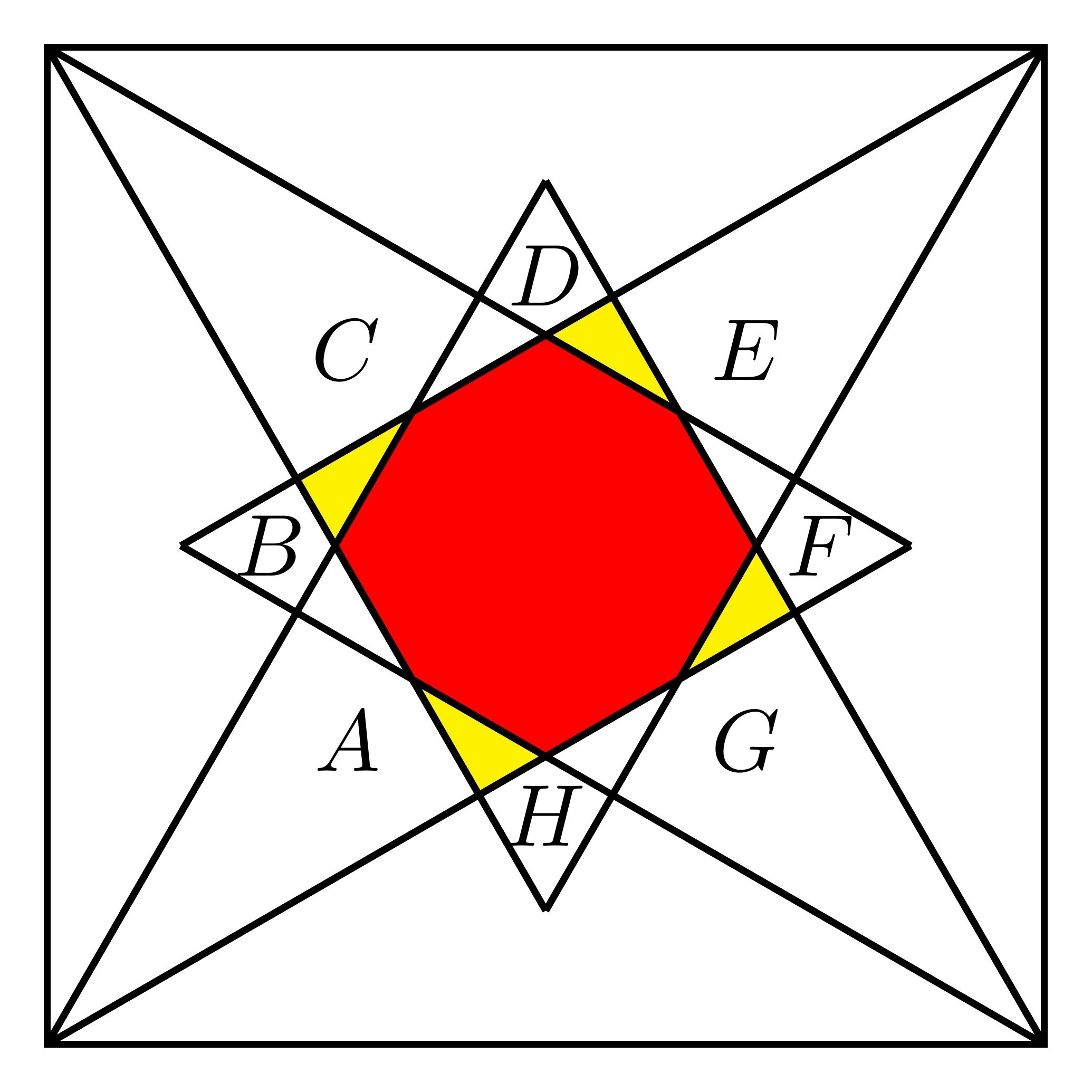
The angles of the octagon alternate between \(120^\circ\) and \(150^\circ\), see the following explanation:
The angles in \(B,D,F\) and \(H\) of the yellow triangles are \(60^\circ\), because the yellow triangles are right triangles.
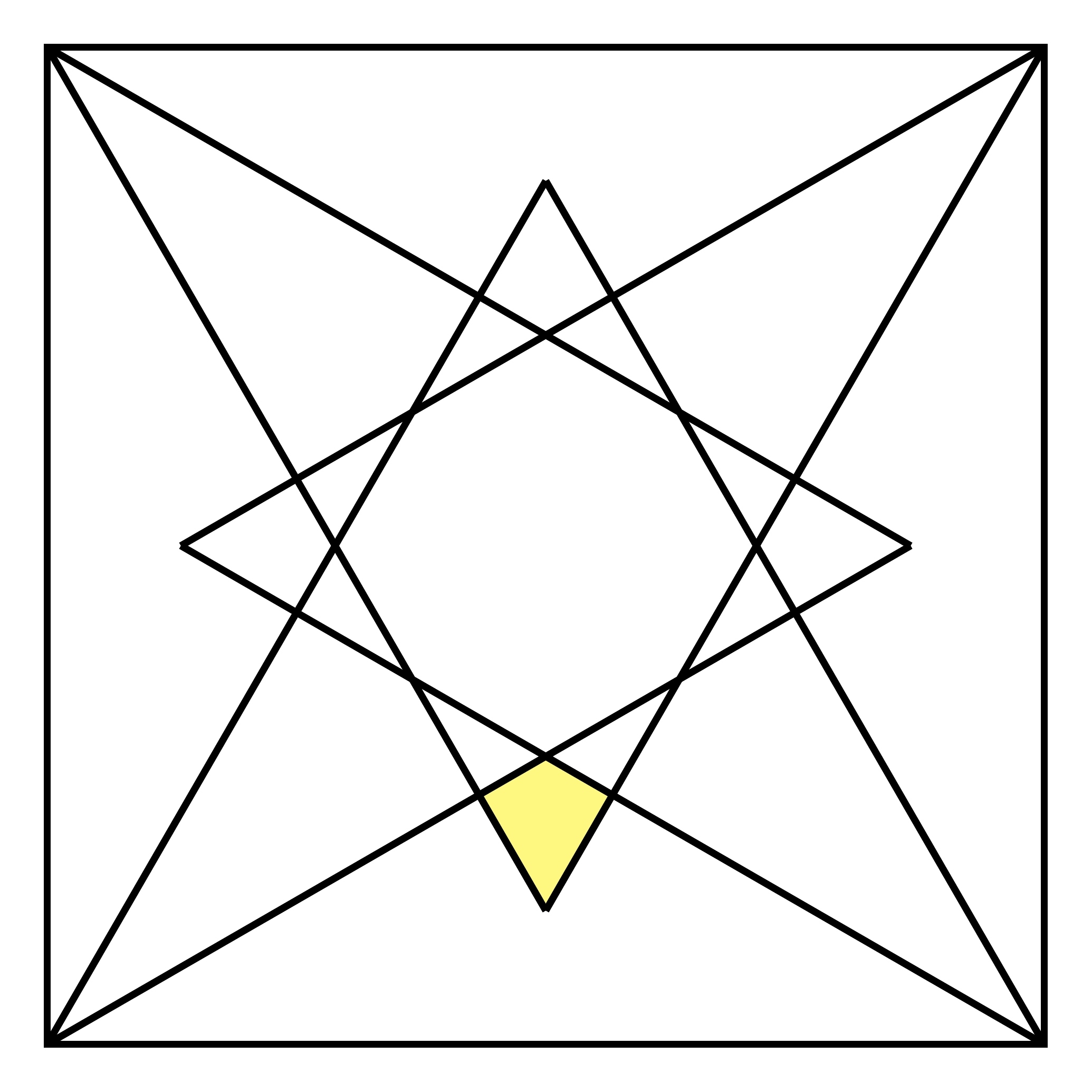
The small kites have two angles of \(90^\circ\),see
and one of \(60^\circ\) because that's a shared angle with an equilateral triangle.
Hence the remaining angle of the kite has to be \(360^\circ- 2 \cdot 90^\circ - 60^\circ = 120^\circ\) and
as they are adjacent angles with the angles of the small triangle, this angles have \(180^\circ - 120^\circ = 60^\circ\).
So the angles of the octagon at \(B,D,F\) and \(H\) are \(360^\circ - 2\cdot 60^\circ - 120^\circ = 120^\circ\).
The sum of the interior angles of an octagon is \(1080^\circ\).
As four of them are \(120^\circ\) and the other all have the same value as the picture is symmetric,
we have that the sum of this four is \(1080^\circ - 4\cdot 120^\circ = 600^\circ\).
So the angles of the octagon at \(A,C,E\) and \(G\) are \(600^\circ : 4 = 150^\circ\).
Hence, we have an octagon with equal side lengths but with angles which alternate between \(120^\circ\) and \(150^\circ\).