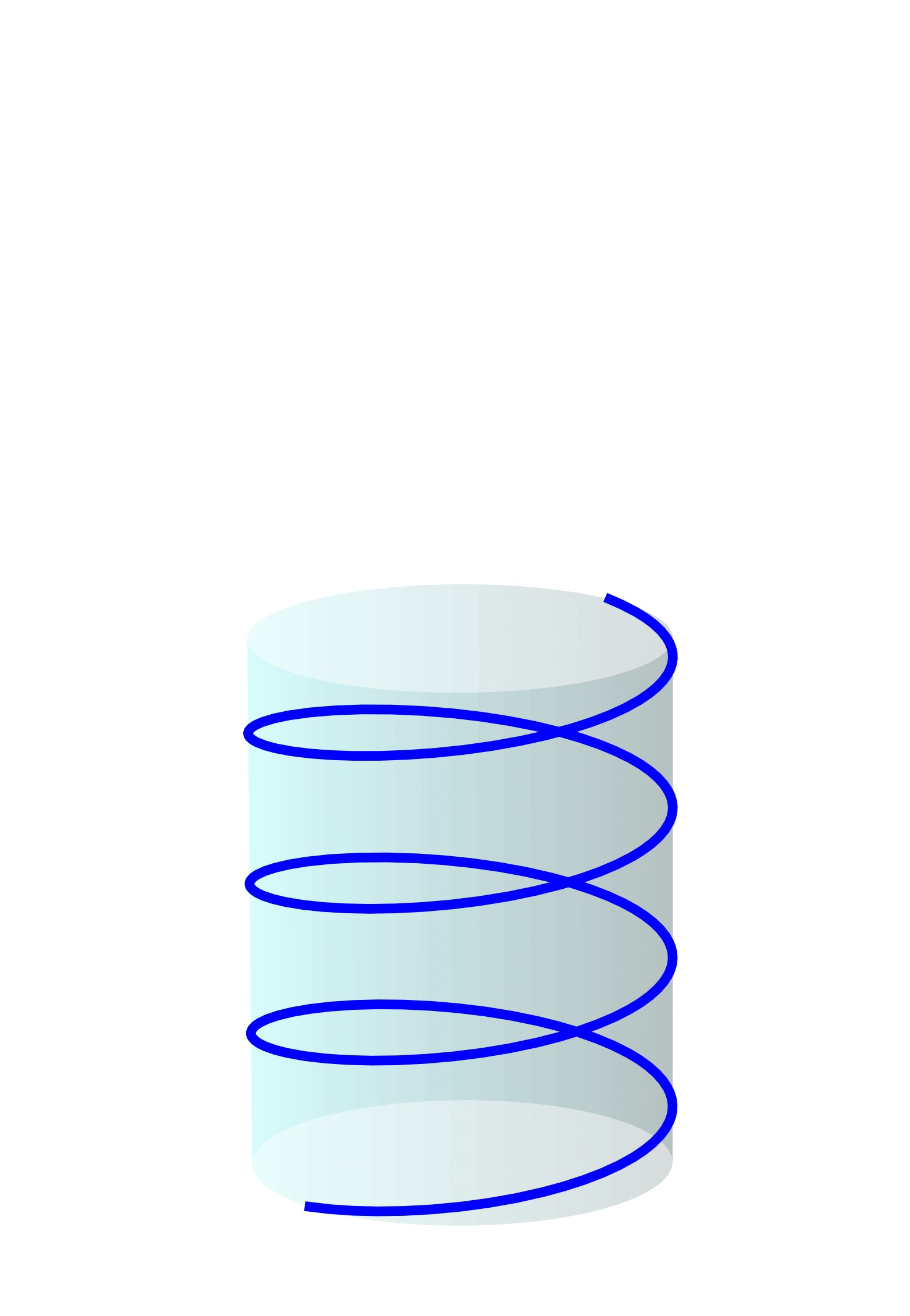
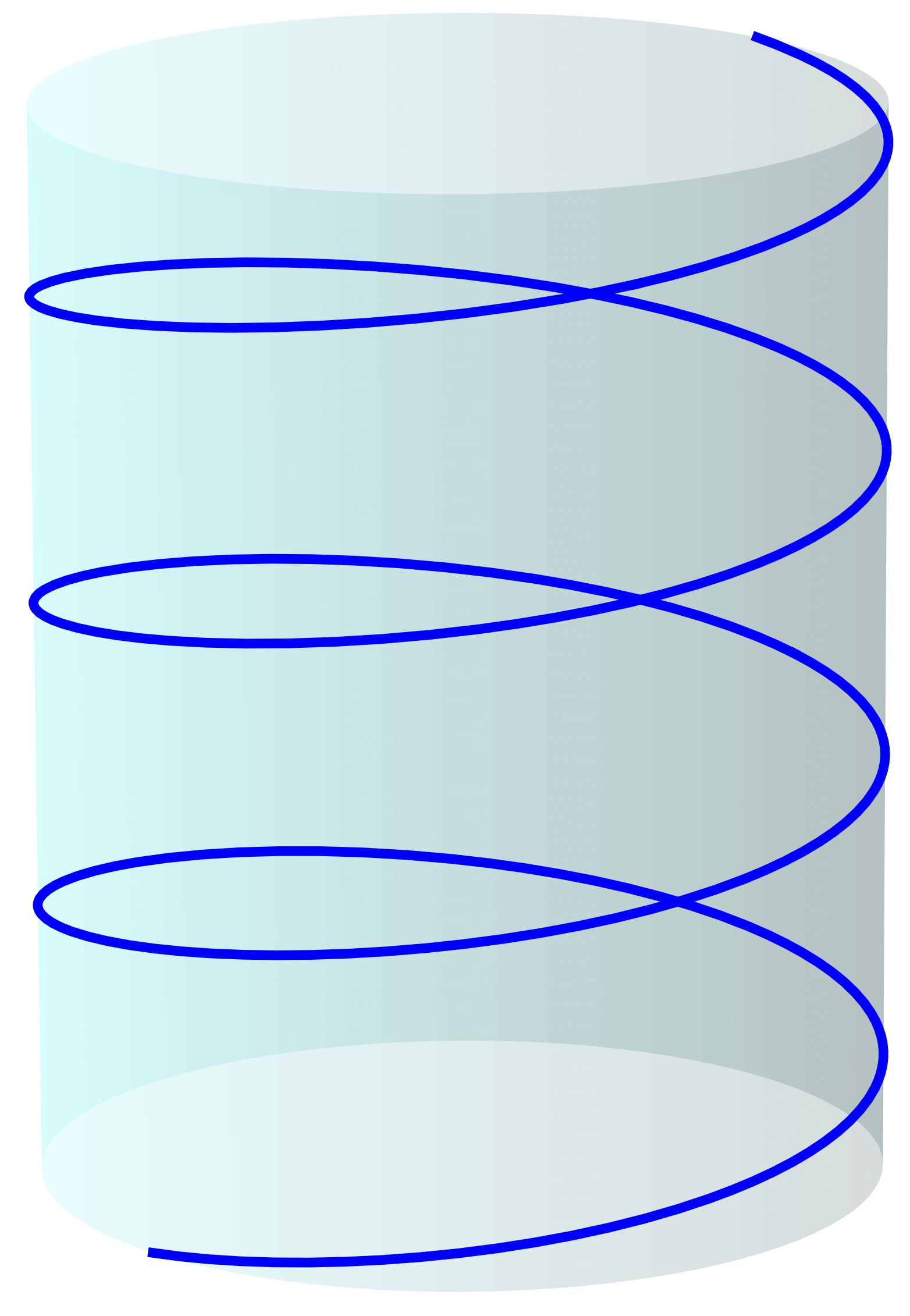
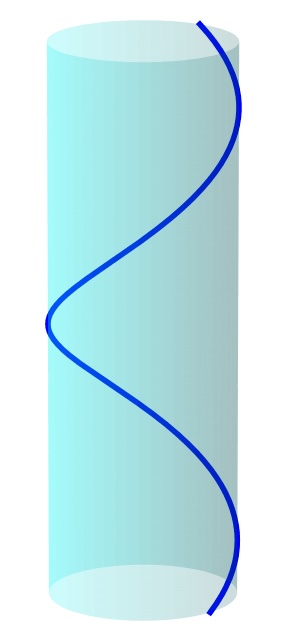
The shape of a cylindrical helix is determined by three parameters:
The radius of the cylinder.
The pitch of the helix.
The handedness of the helix.
Fixing the cylinder
Let’s fix the cylinder and explore how changes in handedness or pitch affect the helix.
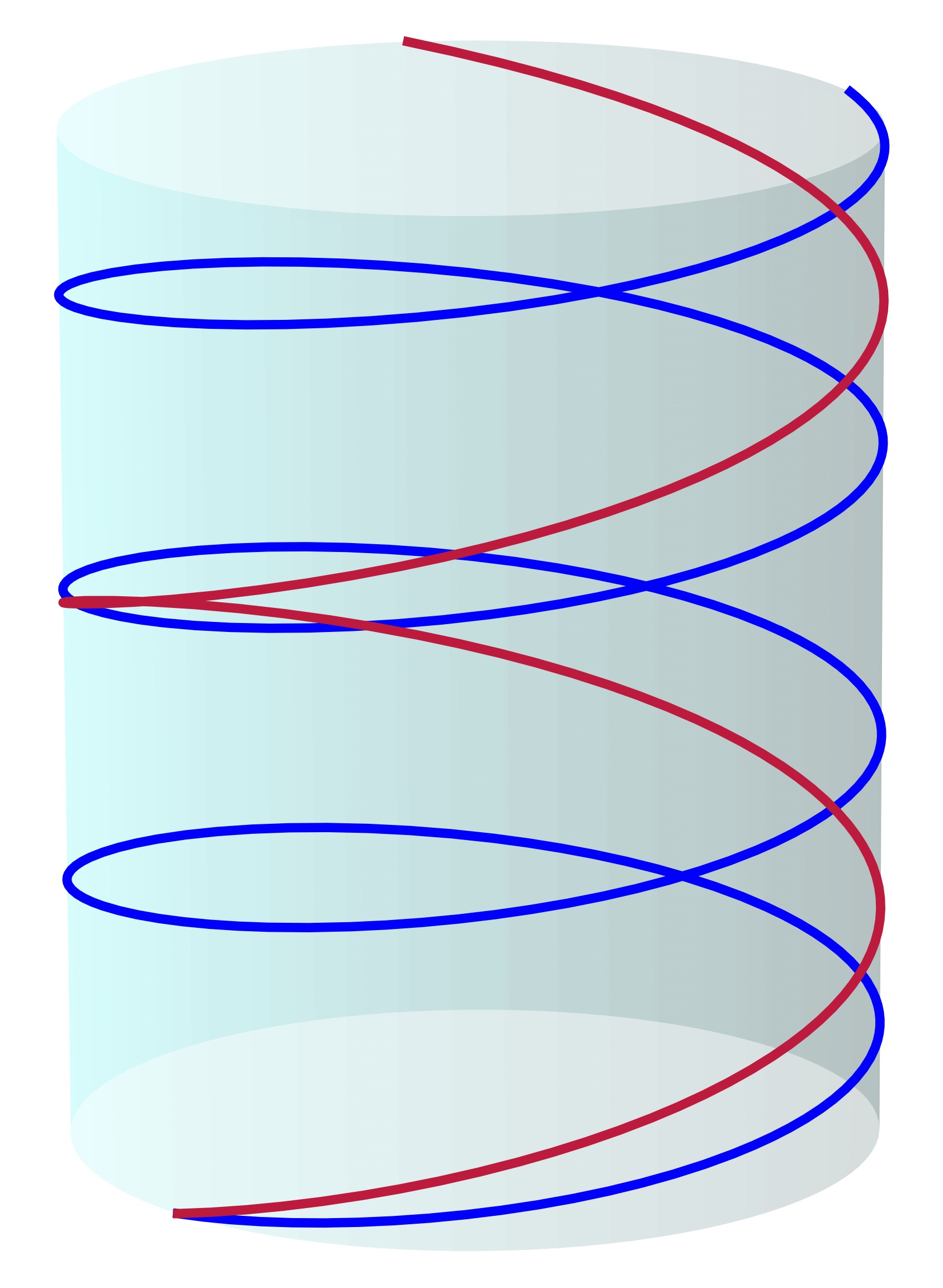
Changing the handedness: If we fix the pitch and apply a plane symmetry (reflecting across a plane parallel to the cylinder’s base), a right-handed helix becomes left-handed, and vice versa.
Changing the pitch: Now we fix the handedness and change the pitch.
Increasing the pitch stretches the helix, making it less tightly wrapped around the cylinder.
For a fixed height, the number of turns around the cylinder axis decreases. More precisely, it is inversely proportional to the pitch.
The slope changes proportionally with the pitch, hence also the helix angle changes.
The curvature
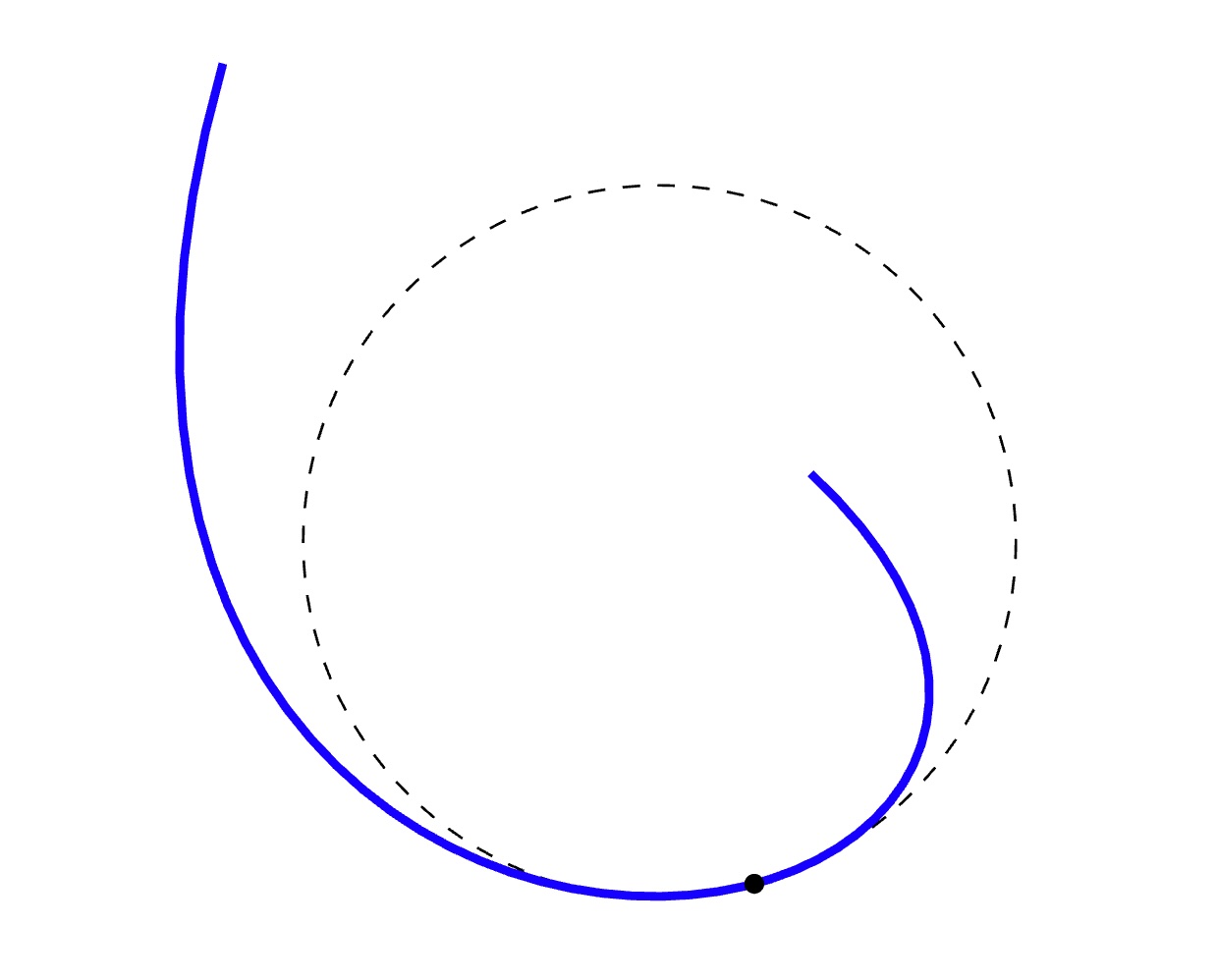
The curvature of a curve at a point measures how sharply it bends at that point.
For a circle, the curvature is constant and defined as the inverse of its radius. Circles with a smaller radius are more curved than those with a larger radius, thus, a smaller radius means higher curvature.
If \(r\) is the radius of the cylinder's surface, the curvature of its base is \(1/r\).
For a smooth curve, curvature at a point is defined as the curvature of the (infinitesimal) circular arc that best approximates the curve at that point.
For a helix, curvature is the same at every point.
The curvature \( \kappa \) of a helix of radius \( r\) and pitch \( p \) is given by
\[
\kappa = \dfrac{r}{r^2 + (p/2\pi)^2} \]
Increasing the pitch reduces curvature, as the helix stretches and its bending becomes gentler (approaching a straight line).
Decreasing the pitch increases the curvature, as the helix tightens and its path more resembles a circular arc around the cylinder. When the pitch approaches zero, the curvature approaches that of the cylinder’s base.
Rescaling the cylinder
If we rescale both the cylinder and the helix by a factor \(F\):
The pitch of the helix scales by a factor \(F\): if \(F\) is larger than \(1\), the pitch increases.
The curvature scales by a factor \(1/F\) (since the radius of the approximating circular arc scales by \(F\)).
The slope remains unchanged (as it is the ratio of two quantities both scaled by \(F\)).
Maximal curvature for a given pitch
The curvature \( \kappa \) of a helix of radius \( r \) and pitch \( p \) is given by:
\[\kappa = \dfrac{r}{r^2 + (p/2\pi)^2}\]
For a fixed pitch, curvature is maximized when the radius satisfies \(r = \dfrac{p}{2\pi}\). Equivalently: \(p = 2 \pi r\). This means that the helix bends most when the pitch equals the circumference of the cylinder base.
For a fixed pitch:
If the cylinder's radius is very large, the curvature becomes small.
If the cylinder's radius is very small compared to the pitch, the helix is stretched, and its curvature is also small.