The length of a helix
If a helix extends infinitely in one or both directions, its length is infinite. Therefore, we focus on finite cylindrical helices.
How do we measure the length of a helix?
- To measure a curved object, we cannot use a straight ruler, but we can use a flexible sewing ruler or a rope:
- Place the rope along the curve, marking the start and end points on the rope.
- Straighten the rope and measure the distance between the marks.
- This distance is the length of the curve.
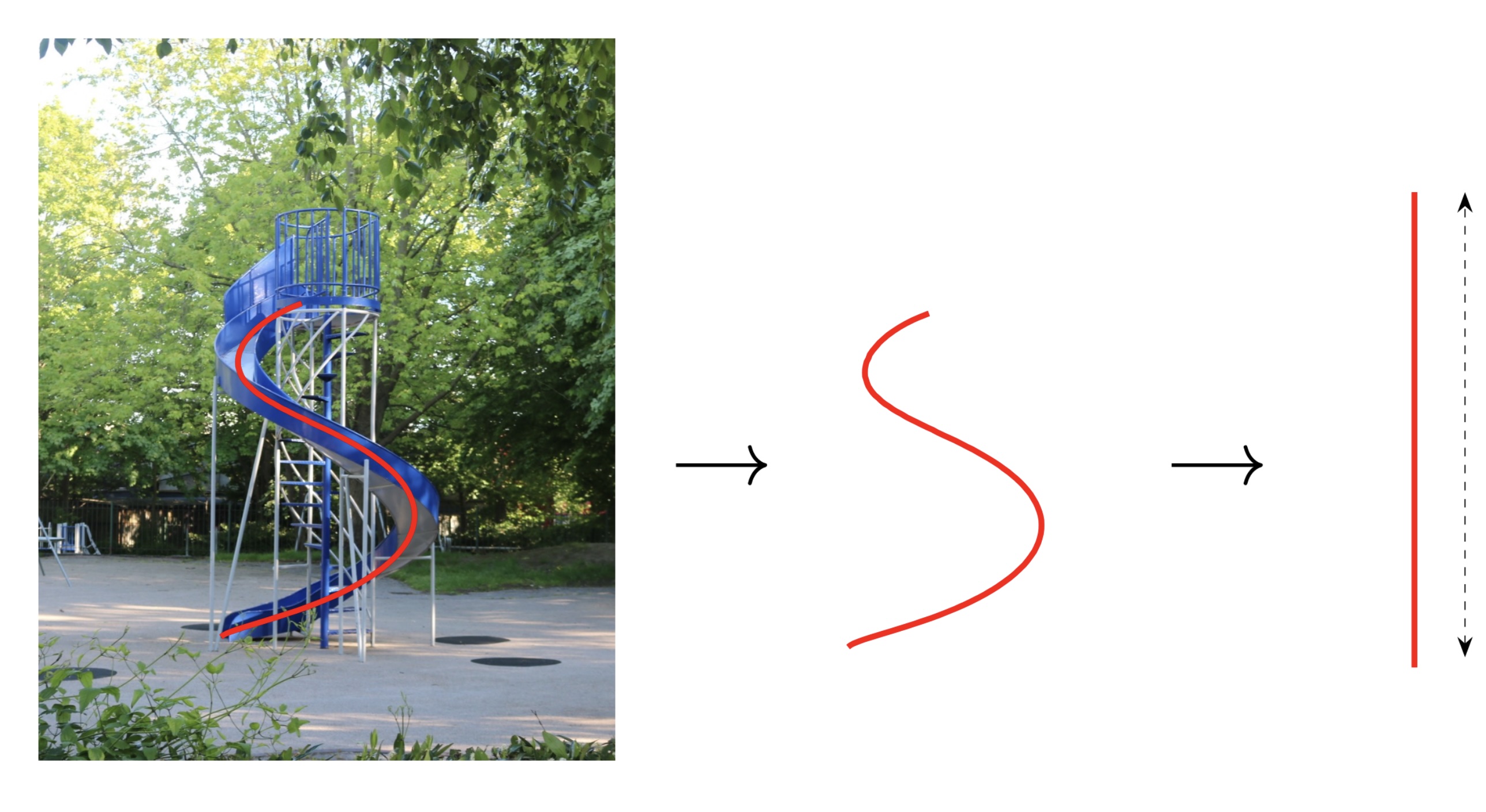
About the picture: reference, CC BY-SA 2.0 (cropped, with added curve).
How long is a helix?
- Orient the cylinder vertically. A helix is longer than its horizontal distance travelled. For one full turn around the cylinder, the horizontal distance travelled is the circumference of the base: \[ 2\pi r < \text{Length (one turn)}\] where \(r\) is the cylinder's radius.
- Moreover, the helix is shorter than the sum of its horizontal distance travelled and vertical displacement (since it moves diagonally). For one turn: \[ \text{Length (one turn)} < 2\pi r + p \] where \(p\) is the helix pitch.
- The exact length of one turn of the helix is: \[\sqrt{(2\pi r)^2+p^2}\]
- We can calculate the length per turn, considering only one complete rotation around the cylinder axis. Using proportionality, this allows us to compute the length for any number of turns.
- Let \(N\) be the number of turns that a point makes along the helix. In geneeral, \(N\) can be any non-negative real number. The total length of the helix is: \[N \cdot \sqrt{(2\pi r)^2+p^2}\]
The formula for the length
- Unrolling the cylinder into a rectangle preserves lengths. Thus, the length of the helix corresponds to the total length of the segments in the rectangle:
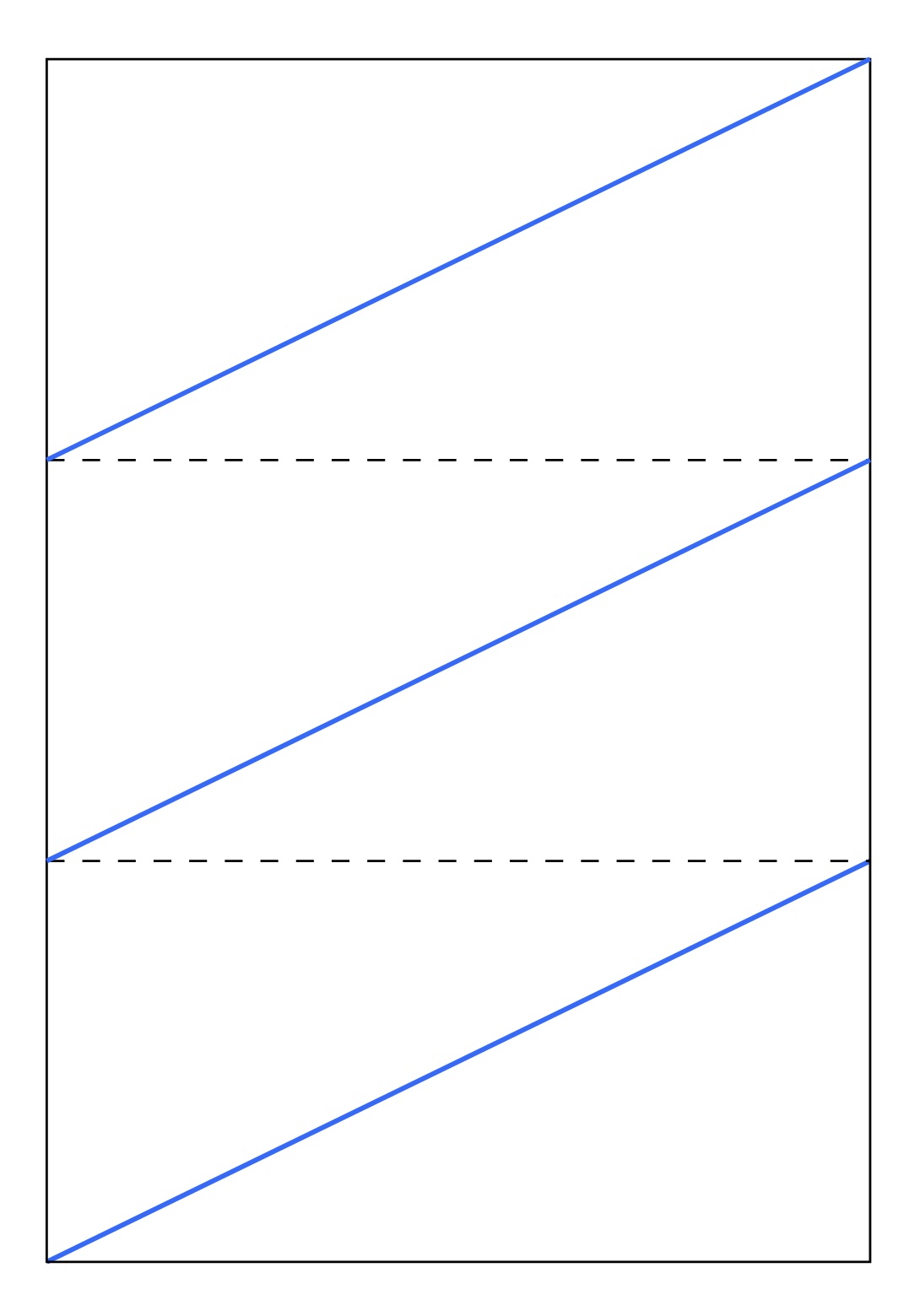
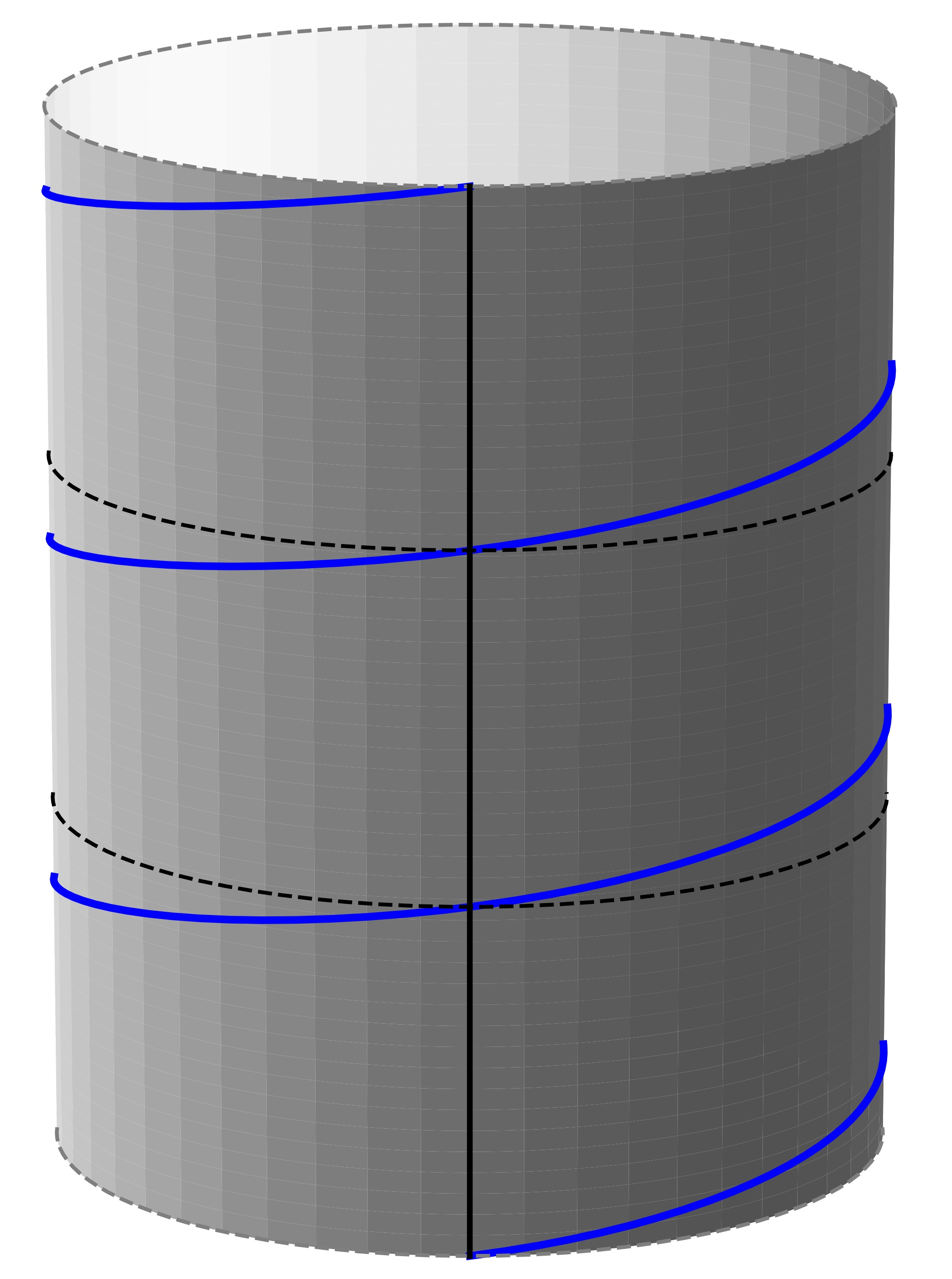
- For one turn (cutting the cylinder at the start and end points), we obtain a single diagonal segment:
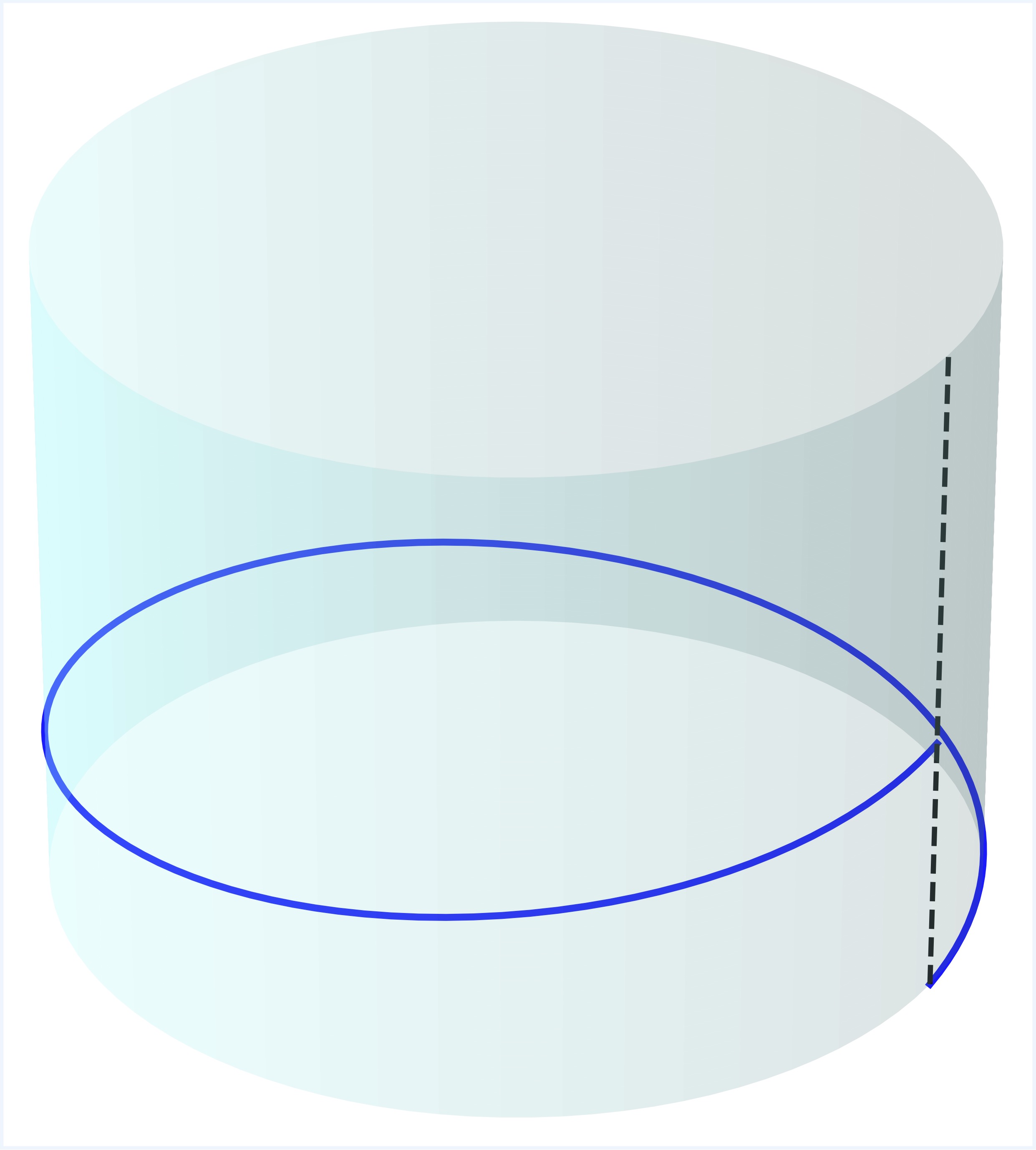
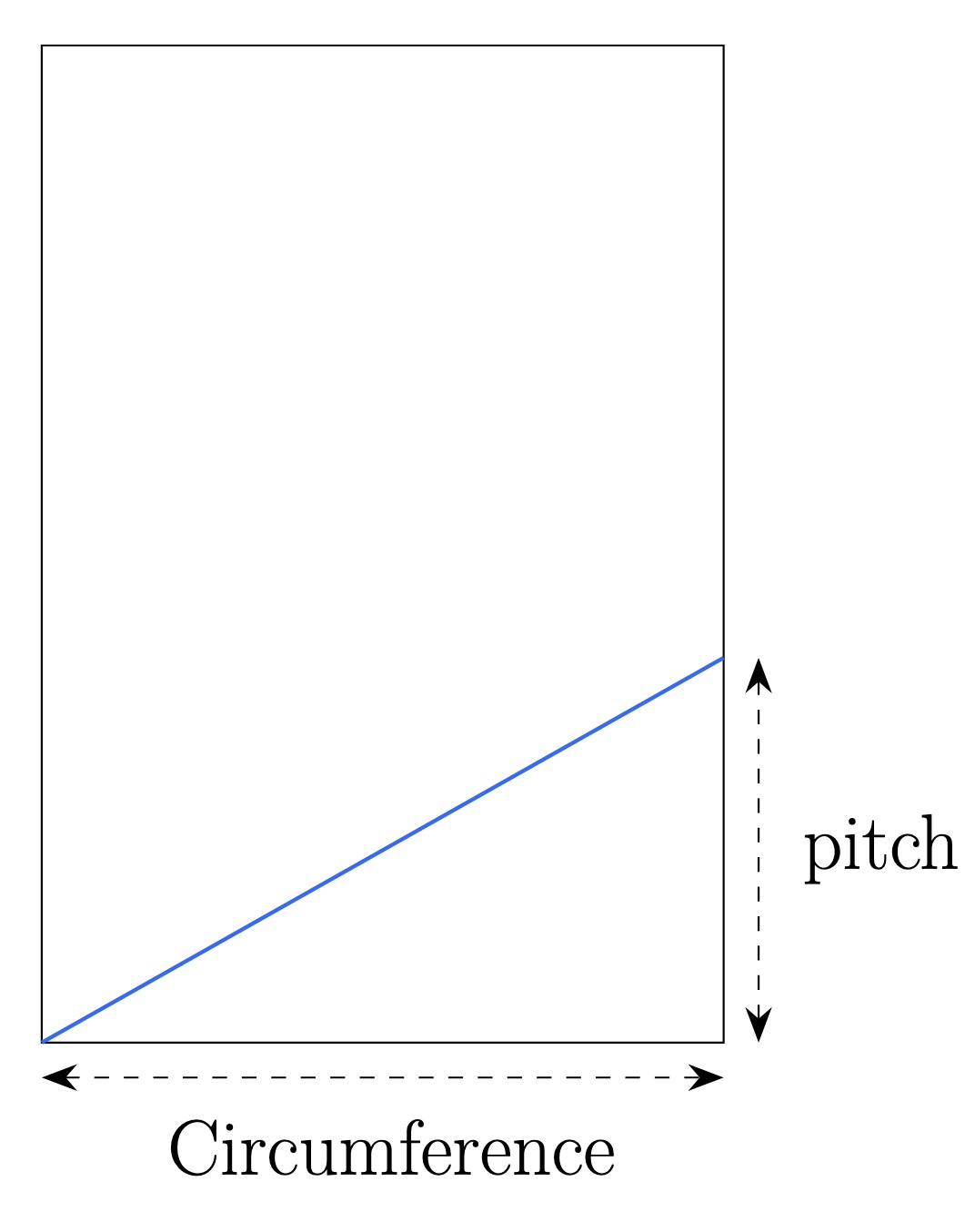
The length of the vertical side is the pitch (\(p\)), while the length of the horizontal side is the circumference of the cylinder base (\(2\pi r\)). By the Pythagorean theorem, the length of the diagonal is: \[\sqrt{(2\pi r)^2+p^2}\]

Shortest curves on a cylinder
A straight line segment is the shortest curve in a plane connecting two points. But what is the shortest curve on a cylinder?- Orient the cylinder vertically.
- If the two points are vertically aligned, the shortest curve is the vertical line segment connecting them.
- If the two points are at the same height, the shortest curve is the shorter (horizontal) circular arc connecting them (unless they are diametrically opposite, in which case there are two equally short horizontal circular arcs).
- If the points are neither vertically nor horizontally aligned, the shortest curve is a helix that makes at most half a turn. This helix is unique, unless the points have opposite horizontal projections (in which case you can choose either a right-handed or left-handed helix).